

















































Control the Breath, Control the Mind: Your Breath Is Your Remote Control

Amit S Sardal is a Fitness Expert, Coach and a Learning & Development professional with 15+ years of experience in exercise science, coaching and developing the next generation of fitness trainers by being a part of the premium fitness academies in the country. A faculty member for postgraduate Master’s in Human Movement programmes affiliated with the University of Mumbai, Amit integrates Strength Training, Yoga, Calisthenics and sustainable lifestyle practices to make fitness practical, purposeful and built for the long haul. His approach is simple: train for strength, move for life, and build habits that last. Working with diverse clients across various age-groups & geographies, he adapts training to individual abilities, needs and goals. Mail him on sardalamit@gmail.com for a customized plan.
It’s a beautiful day. You are focused on your work, also catching up on office gossip. It’s a cosy, air-conditioned cabin. Spacious. The coffee is good, the chair is comfortable.
Then, a call to your reporting manager. Just then your TL and your HR walk in. Their informal tone in greeting you suddenly pulls you to a more erect posture. When the TL starts off by listing your issues (true or not), the client complains, all SOPs you did not follow- you find your heart rate shooting up, your breathing becoming faster, your pupils dilate and your eyelids elevate. Does this sound familiar?
Mental health is a very broad term. Anxiety, depression, panic disorders, inattention, chronic stress and other psychological conditions are not the same thing. But especially with anxiety, panic and stress-related states, many of us recognise some common experiences: racing thoughts, a pounding heart, and a change in breathing; breathing that becomes quicker and shallower.
There is one interesting point of overlapping here: the mind affects breathing. Stress/ anxiety changes your breathing. However, as we shall see, breathing also affects the mind.
The physiology behind stress: Our nervous system has multiple components to it. For what we are discussing, it can be broadly classified as:
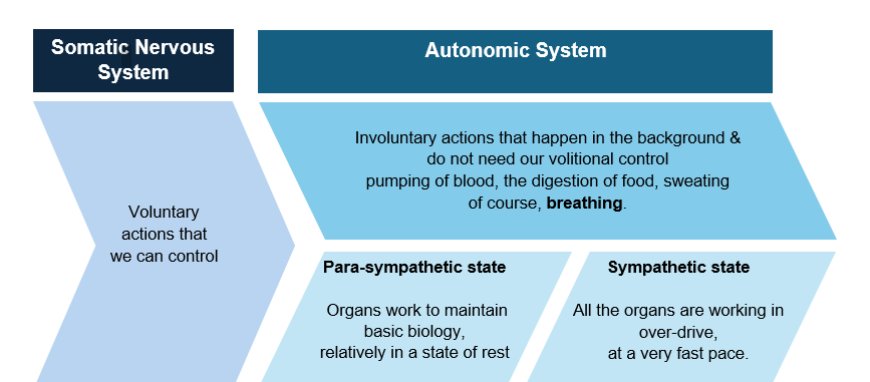
Consider the situation: you accidentally step on a dog’s tail. At that point, your nervous system and hormonal system will start signaling all systems of your body to run away from there. Your liver will dump a huge amount of glucose in the bloodstream. The glucose will need oxygen to burn which will be provided by the respiratory organs working in over-drive. The oxygen and the glucose will have to be sent to all the cells of the body for more energy and hence the heart will have to pump more blood. This is what we call a Sympathetic state of the body where it’s a fight or flight mode.
We needed that, in this case, as the energy helped us run away from the dog. It is what at some point in time helped us club a competitive caveman, fight the bear, hunt a deer. The breathing in this case is elevated as a survival mechanism.
Coming back to the office, while logically we understand our life is not in danger, parts of our brain are still not able to distinguish between an animal charging us versus an HR with animated body language. It’s when these deeper parts of the limbic system of the brain take over the newly evolved cortex, that we have a problem. The problem is that the entirety of these states is difficult to control directly. Telling yourself, “Stop being anxious.” Or” Just Calm down,” usually does not work particularly well.
This is where the Somatic part of our nervous system, which allows us certain control over muscle contractions come into play. You can control some of your breathing voluntarily!
So rather than fighting the anxiety and the crippling state the body is in, we control our breathing and nudge the autonomic system to slowly return to a state of rest.
This is where Pranayama becomes extremely practical.
You do not need an elaborate 30-minute routine. Start by simply learning how to breathe fully.
Some people breathe predominantly through movement of the upper chest. Others, after being taught only “belly breathing,” A full breath should comfortably involve both.
Try this:
Sit comfortably with your spine upright. Place one hand on your abdomen and the other around your chest or lower ribs.
● Inhale gently through the nose for approximately four seconds.
● Feel the rib cage and chest expand and then allow the abdomen to expand.
Do not suck in the biggest breath you possibly can. Deep breathing should not mean forced breathing.
● Now exhale slowly for approximately six seconds, allowing the abdomen and the chest to relax.
At the end of the exhalation, pause for a second or two if it feels comfortable.
● Then inhale again.
Do this for about five minutes.
v No heroic breath-holding. No straining. No competition to see how slowly you can breathe. If you become dizzy or uncomfortable, return to your normal breathing.
v Now add one more component: your attention. Focus only on the breathing and nothing else.
v For those five minutes, follow the breath. Inhale. Feel the movement. Exhale. Feel yourself emptying the breath. Notice the small pause.
v Your mind will wander. Bring it back to breathing. It will wander again. Bring it back again.
And this takes us beyond breathing into the larger purpose of Yoga.
Patanjali describes Yoga as Chitta- Vritti-Nirodhaha, the stilling of the fluctuations of the mind.
We cannot always decide which thought will appear next. Neither do we need to become slaves to every thought or emotion that appears. Sometimes trying to control the mind directly is the hardest route. So, begin with something more tangible. Slow down the breath, slow down the cacophony in your mind from everything fighting for your attention. Sometimes, that is a very good place to start.
Control the breath. Control the mind.
An important disclaimer: If you are experiencing mental-health symptoms, suspect that you may have a mental-health condition- please consult a qualified medical professional. Breathing exercises/ Pranayama can be a supportive practice. It is not a replacement for diagnosis, psychotherapy or medication, and its therapeutic use should complement the treatment advised by your doctor.
What's Your Reaction?